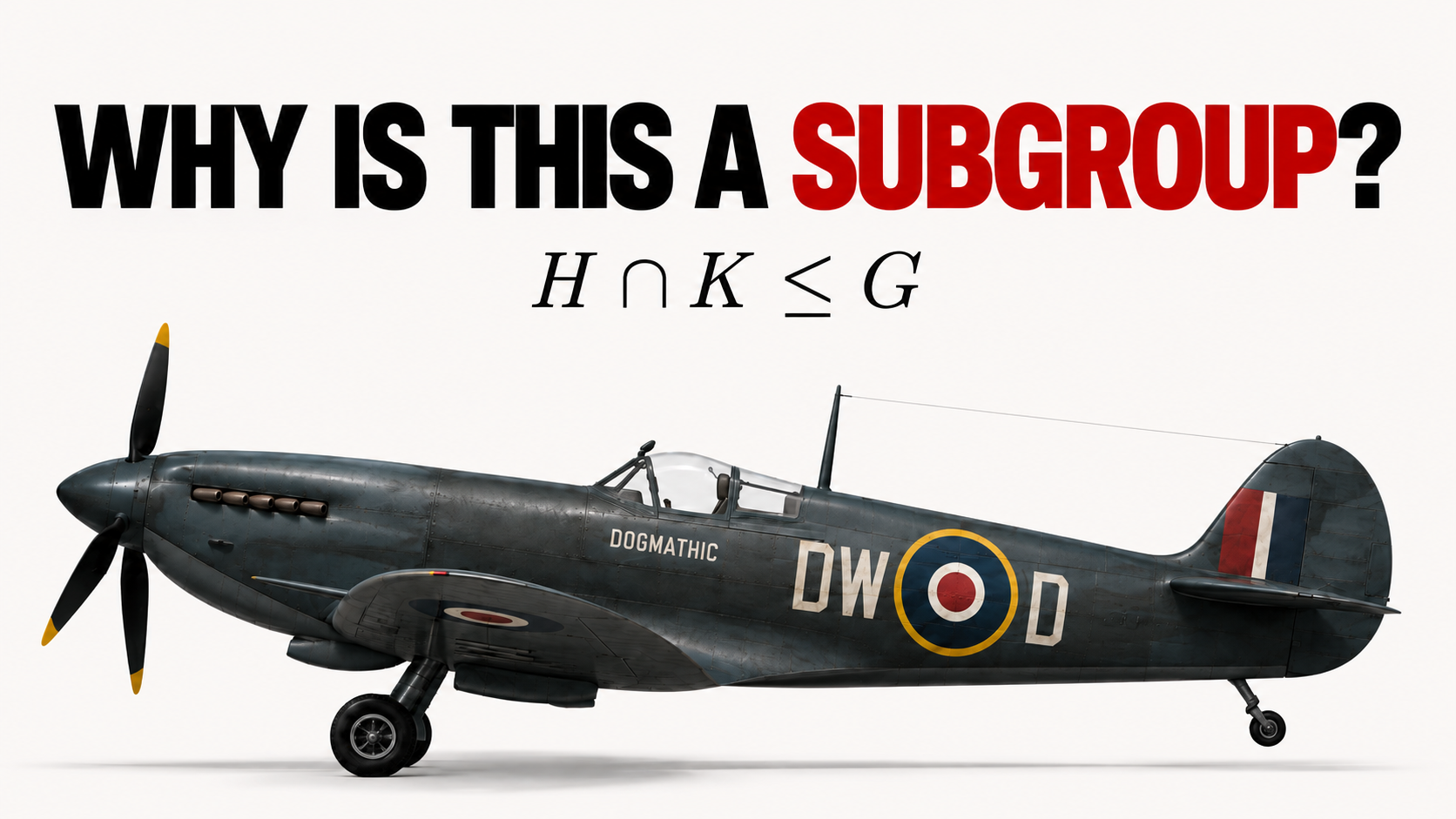
Suppose and are subgroups of a group . Even if and are very different subgroups, the elements they have in common still form a subgroup.
In other words,
Why does this always work? The subgroup test gives us a short proof.
The Intersection of Two Subgroups
Because and K are both subgroups of , they each contain the identity element. Therefore,
so the intersection is nonempty.
Now we only need to check that the intersection satisfies the subgroup test.
Proof Using the Subgroup Test
Take any two elements .
Because and are in the intersection, they belong to both subgroups:
and
Since is a subgroup,
Since K is also a subgroup,
Therefore belongs to both and , which means
So is nonempty and closed under the subgroup test.
Therefore, .
A Simple Example
Consider the group of integers under addition.
Let and
contains all multiples of , while contains all multiples of .
An integer belongs to both groups exactly when it is a multiple of both and . Therefore,
.
And is itself a subgroup of .
The Intersection Can Be Small
There is no requirement that contain many elements.
Two subgroups may have only the identity element in common. In that case,
.
But the trivial subgroup is still a subgroup, so the theorem continues to hold.
The intersection can also equal one of the original subgroups. For example, if
then every element of already belongs to , and therefore
.
So the intersection can range from the trivial subgroup all the way up to one of the original subgroups.
More Than Two Subgroups
The same idea extends beyond two subgroups.
If we take any collection of subgroups of , their intersection is again a subgroup of . An element in the intersection belongs to every subgroup in the collection, so applying the subgroup test keeps us inside every one of them.
That makes intersections one of the basic ways of constructing new subgroups from ones we already know.
Watch the Video
Want the notes?
Download the free video notes:
https://dogmathic.com/SubgroupIntersection
More Dogmathic
Explore more Math Notes:
Get occasional Dogmathic email updates:
Leave a Reply